

How to Identify Authentic Southern Memorabilia
Table of Contents
- What Counts as Southern Memorabilia and Why Authentication Matters
- Step 1: Examine Physical Characteristics and Materials
- Step 2: How to Authenticate Civil War Memorabilia Through Documentation
- Step 3: Research Confederate Memorabilia Provenance and Ownership History
- Reproduction Versus Authentic Historical Memorabilia: Spotting the Difference
- Historical Memorabilia Appraisal and Professional Authentication
- Buying Southern Memorabilia Online: Verification Checklist
- Frequently Asked Questions
Last Updated: October 7, 2026
What Counts as Southern Memorabilia and Why Authentication Matters
Southern memorabilia includes Civil War artifacts, Confederate flags, historical documents, period coins, vintage prints, and regional collectibles tied to the American South's heritage.

Authentication matters because dishonest sellers mix fakes with genuine pieces, and without verification you risk spending significant money on worthless copies.
This guide walks you through the steps to identify authentic southern memorabilia, from examining materials to researching provenance.
Step 1: Examine Physical Characteristics and Materials
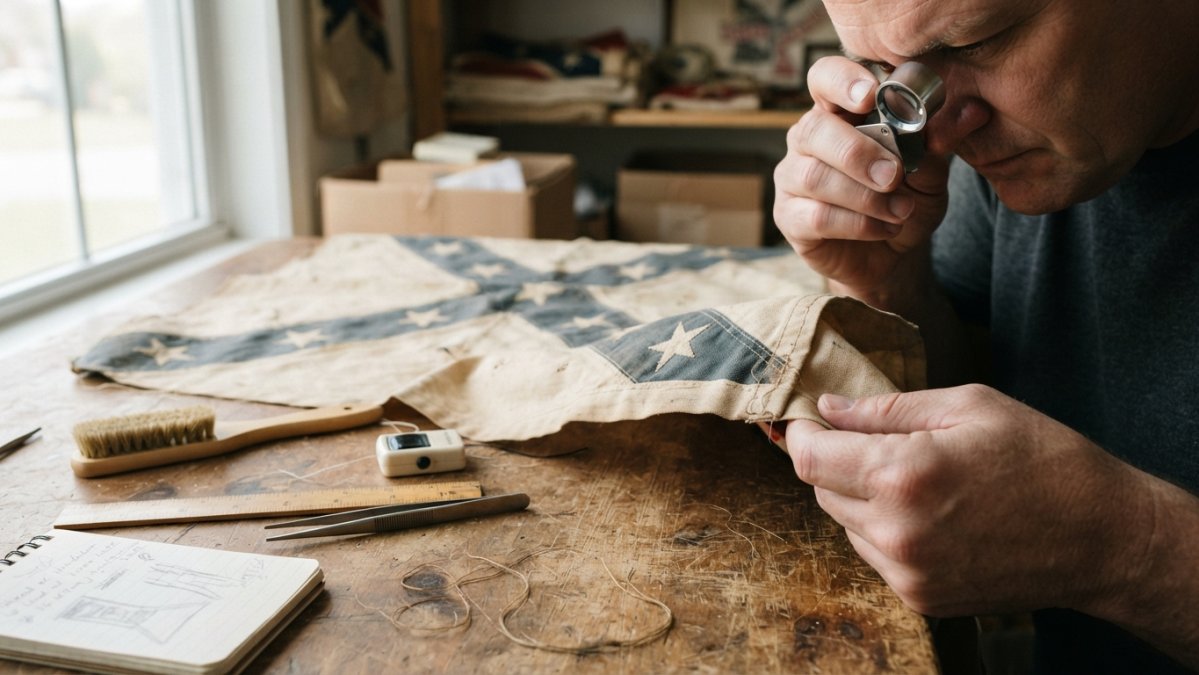
The first step in identifying authentic southern memorabilia is close physical inspection: how the item was made, what materials were used, and whether they match the claimed era.
Age and Condition Clues
Authentic items show wear matching their age: natural fading, patina, and deterioration consistent with the period. A flag claimed to be from 1861 shouldn't have bright colors or pristine stitching.
Real age shows in specific ways:
- Fabric becomes brittle and develops small tears over decades
- Embroidery threads fade unevenly based on sun exposure
- Metal components develop authentic rust or patina
Reproductions often look artificially aged, with uniform wear from chemical or mechanical methods. Authentic wear is random and irregular.
Workmanship and Construction Details
Examine construction. Hand-stitched 1800s items show inconsistent stitch length; modern reproductions feature perfectly uniform machine stitching.
Check these construction details:
- Stitching patterns: Authentic Civil War-era flags use hand-stitching with natural variations in thread tension
- Seams: Original pieces show seams that aren't perfectly straight
- Hems: Authentic hems are often uneven with visible repair work
Materials matter too. Authentic flags from the 1950s-1980s, like the 1956 Old Georgia State Flag in 600D nylon, have a weight and texture matching period manufacturing. Modern reproductions use different fabric blends that feel noticeably different.

Step 2: How to Authenticate Civil War Memorabilia Through Documentation
Documentation transforms a suspicious item into a verified piece. Civil War memorabilia requires specific paperwork and signatures to establish legitimacy.
Signatures and Autograph Verification
Signatures are your strongest authentication tool. Compare them against known authentic examples from the same person.
Key verification steps:
- Pen pressure: Authentic signatures show natural variation. Forged signatures often have uniform pressure
- Fluid strokes: Real signatures have natural flow and connected strokes. Forgeries appear hesitant or shaky
- Natural variation: Even the same person's signature varies slightly each time. Perfect consistency indicates a forgery
For Civil War-era documents, compare signatures against documented examples in historical archives or museum collections, many of which publish authenticated samples online. If the signature doesn't match known examples, the document is likely fraudulent.
Authentication Certificates and Official Tags
Legitimate memorabilia often comes with third-party authentication certificates providing an official record of verification.
What to look for in certificates:
- Certificate issued by a recognized authentication service or museum
- Specific item description and condition assessment
- Authenticator's credentials and signature
Official tags and labels matter too: vintage items from licensed manufacturers include maker's marks, while reproductions lack these details or include poorly printed versions.
Step 3: Research Confederate Memorabilia Provenance and Ownership History
Provenance is an item's documented ownership history. Strong provenance proves authenticity and increases value; without it, even visually authentic items become questionable, for Southern and Civil War-era pieces, it often separates a museum-grade artifact from a decorative reproduction.
A Practical Provenance Research Workflow
Most collectors treat provenance as a yes/no question: does the seller have paperwork? A better approach is to build an evidence packet link by link. Experienced collectors often require at least three independent, dated links before treating an item as well-provenanced.
Work through these steps in order:
- Start with the object itself. Look for inscriptions, engraved initials, unit markings, owner names, dates, or inventory numbers, the most durable provenance clues, usually added at or near the time of use.
- Photograph and transcribe every mark. Record exact spelling, handwriting style, and placement. "J. Whitfield, 14th Ga." is a research lead; a vague "Confederate soldier" is not.
- Search archival records. The National Archives (NARA) holds compiled military service records and pension files for Confederate soldiers, and many Southern state archives maintain rosters. A name plus a unit often confirms whether a person existed and served.
- Check newspaper and county records. Southern county courthouses, state historical societies, and digitized archives like Chronicling America can confirm residence, estate sales, and family transfers.
- Trace the sale history. Auction archives, dealer catalogs, and estate records show when an item changed hands. A documented auction sale from decades ago beats a verbal claim of "been in the family."
- Look for published references. Items pictured in books, museum catalogs, or historical society journals carry a publication trail that is difficult to fake.
What to Request From a Seller
Ask for a written provenance statement, not a verbal one, including:
- Names of previous owners and how each acquired the item
- Dates of transfer where known
- Copies of receipts, bills of sale, or auction records
If a seller won't provide written documentation, treat the item as unprovenanced and price it accordingly. Unprovenanced doesn't automatically mean fake, but you're buying on physical evidence alone, so pay a price reflecting that risk.
Comparing Your Item with Known Authentic Examples
Direct comparison remains one of the most reliable authentication methods. Museums, universities, and historical societies across the South maintain collections of authenticated items you can examine in person or through published catalogs.
Comparison checklist:
1956 Old Georgia State Flag 3' x 5' 600D Nylon Sewn and Embroidered →
- Visit regional museums and historical societies with Civil War and Southern history collections
- Compare construction methods, materials, thread type, and wear patterns
- Note differences in design details, proportions, and manufacturing techniques
Many institutions allow researchers to examine authenticated items by appointment or provide detailed photographs. This hands-on comparison reveals subtle differences, thread twist, dye lot, weave density, that separate authentic pieces from reproductions.
Reproduction Versus Authentic Historical Memorabilia: Spotting the Difference
The line between reproductions and authentic pieces isn't always obvious. Understanding common reproduction techniques helps you spot fakes quickly.
Common Counterfeit and Alteration Red Flags
Certain red flags indicate an item is likely a reproduction or altered piece:
Major red flags:
- Too perfect condition: Authentic items show age. Items that look brand new are suspect
- Uniform wear: Real wear is random and irregular. Uniform aging suggests artificial treatment
- Inconsistent materials: Items mixing old and new materials indicate alterations
Alterations are common too. Watch for:
- Replaced components (new grommets, stitching, or backing)
- Added signatures or dates
- Artificially aged materials
Historical Memorabilia Appraisal and Professional Authentication
Sometimes you need expert help. Professional appraisers and authentication services provide official verification for valuable items, but for Southern and Civil War-era memorabilia, the decision also involves legal, ethical, and cultural considerations most general guides skip.
When Professional Authentication Is Worth the Cost
Not every item justifies professional review. Authentication is a business decision: you spend money to reduce uncertainty, and it only makes sense when the potential value or risk is high enough.
Consider professional authentication when:
- The item is worth significant money or is being considered for insurance
- Provenance is unclear, incomplete, or relies on a single verbal claim
- The piece is rare, historically important, or tied to a named individual or unit
For low-value decorative reproductions, authentication usually costs more than the item is worth. It generally makes sense when the item's realistic market value is at least several times the authentication cost.
What Professional Authentication Actually Involves
Reputable authentication services for Southern and Civil War-era items typically combine:
- Physical examination by a specialist in the relevant category (flags, documents, uniforms, edged weapons, photographs)
- Materials analysis, including thread type, fabric weave, ink composition, and paper fiber
- Comparison against documented reference collections and known authentic examples
Be cautious of any service issuing a certificate without examining the item in person or documenting its methods. A certificate is only as strong as the evidence behind it.
Legal, Ethical, and Cultural Considerations
Southern memorabilia, particularly Confederate-era items, intersects with legal and ethical questions. Responsible collectors should know:
- Legal restrictions vary by jurisdiction. Some items, such as certain Confederate battle flags and symbols, are regulated or restricted in particular contexts in some U.S. states and on some platforms. Rules change, so verify current law in your location and the policies of any marketplace you use before buying or listing.
- Provenance can raise title questions. Items with unclear ownership history, especially those that may have been removed from public collections or family estates without documentation, can carry legal risk.
- Presentation matters. How an item is displayed, described, and contextualized affects how it is received. Many museums and historical societies now present Confederate-era materials with historical context rather than as celebration.
None of this replaces your own judgment, but it's part of buying Southern memorabilia responsibly, a step most online guides omit.
Third-Party Authentication Services and What They Provide
Several organizations authenticate historical memorabilia, including specialists in Civil War artifacts, autographs, and period documents. A good service provides:
- Physical examination by a trained specialist
- Detailed condition and materials assessment
- Historical and archival research
Costs vary widely by item value and complexity. Expect authentication to be a meaningful fraction of the item's value, if the fee approaches the item's worth, the economics don't work.
Protecting the Item During Authentication
One rarely mentioned risk: authentication and shipping can damage fragile period fabrics, papers, and metals. Before sending anything to a service:
- Photograph the item thoroughly in its current condition
- Ask the service how it handles, stores, and returns items
- Confirm insurance coverage during transit and while in the service's possession
Buying Southern Memorabilia Online: Verification Checklist
Online purchases carry extra risk since you can't physically inspect items first. Use this checklist before committing to a purchase.
Before you buy:
- Request detailed photos from multiple angles, including close-ups of stitching and materials
- Ask for complete provenance documentation and ownership history
- Verify the seller's reputation through independent reviews and feedback
When shopping at Old Resaca, you benefit from our commitment to quality and our risk-free 30-day return policy. If you have concerns about authenticity or condition, our returns process is straightforward with no hassles.
| Authentication Method | Time Required | Cost | Best For |
|---|---|---|---|
| Physical inspection | 30 minutes | Free | Initial screening |
| Signature comparison | 1-2 hours | Free-$50 | Documents with signatures |
| Provenance research | Several hours | Free-$100 | Establishing ownership history |
| Professional appraisal | 1-2 weeks | $100-$500+ | Valuable or rare items |
| Museum consultation | 2-4 weeks | Free-$200 | Expert historical context |
Identifying authentic southern memorabilia protects your investment and preserves genuine historical pieces. At Old Resaca, we help collectors access authentic southern heritage items with confidence. Check Out Our Ebay Store to explore our carefully selected collection of flags, prints, and historical memorabilia backed by our commitment to quality and customer satisfaction.
Frequently Asked Questions
How do I know if Southern memorabilia I'm buying online is actually authentic and not a cheap reproduction?
Check three key areas: physical construction (hand-stitched seams, period-appropriate materials, natural aging), documentation (certificates of authenticity, provenance records, seller history), and comparison (examine photos against museum examples and known authentic pieces). Reproductions typically show uniform aging, modern fasteners, or machine-perfect stitching. Request detailed photos of wear patterns, signatures, and maker's marks before purchase. Old Resaca provides historically accurate items with clear sourcing, ask sellers directly about their authentication process and return policies, which protect you if an item doesn't meet authenticity standards.
What should I check before buying Southern memorabilia to verify authenticity?
Verify age through materials and construction methods specific to the era. Examine signatures or autographs for natural variation in pen pressure and fluid strokes rather than perfect uniformity. Check for official tags, labels, or maker's marks consistent with the claimed period. Research the seller's reputation and request documentation of provenance, where the item came from and who owned it. Ask if the item has been appraised or authenticated by a third party. Look for red flags like suspiciously low pricing, vague sourcing, or packaging that seems designed to hide the item's nature. Old Resaca's 30-day return policy gives you recourse if authenticity concerns arise after purchase.
How do I authenticate Civil War memorabilia like flags, coins, or uniforms?
Civil War artifacts require period-specific knowledge. For flags, examine the dye composition, weave pattern, and stitching technique, pre-1865 flags show hand-embroidery and natural fiber aging distinct from modern reproductions. For coins, check weight, metal composition, and die characteristics against documented originals. For uniforms and textiles, inspect buttons, thread type, and construction seams. Coins of the CSA Replica Coin Set illustrates the difference: replicas use modern metal alloys and precise manufacturing, while authentic pieces show period-appropriate wear and hand-struck variations. Consider professional appraisal for high-value items; expert examination can identify alterations, repairs, or forgeries that casual inspection misses.
What documentation should I have for authentic Southern memorabilia?
Authentic items should include or be accompanied by: an authentication certificate from a recognized third party, provenance documentation tracing ownership history, original packaging or labels if applicable, and photographic records of condition. For signed items, comparison samples showing the signer's authentic signature variations help verify legitimacy. Historical records, newspaper clippings, family letters, auction catalogs, or museum documentation, strengthen provenance. If you're purchasing from a seller, request written details about where they acquired the item, its age, any repairs or alterations, and why they believe it's authentic. This documentation protects your investment and supports resale value.